Episode 2: The Gate
Previously: On the eve of her wedding to Kwame Owusu-Ansah, Adjoa received a voice note from her first love, Yaw, back in Accra after six years abroad. At midnight, someone knocked softly on her family’s gate.
The gate hinge creaked the way it always did — her father used to say that hinge would outlive all of them, still complaining long after everyone who ever oiled it was gone — and there, under the dead security light, stood Yaw Boateng, hands shoved into his pockets like a boy waiting outside a headmaster’s office.
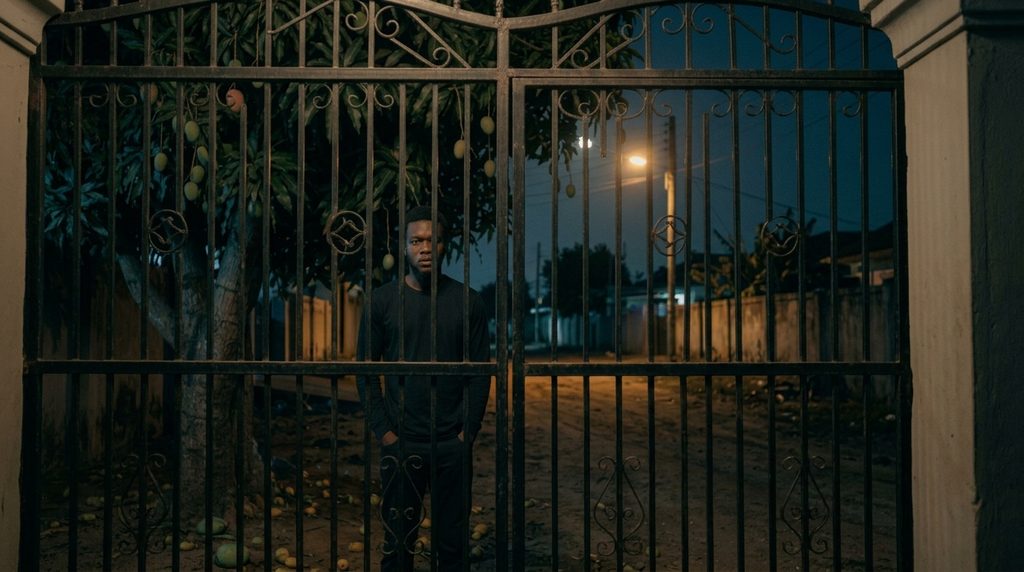
He looked older than his voice note had let on. Six years had thickened his shoulders and put the first serious lines at the corners of his eyes, but he still stood the exact same way, weight rocked back slightly onto his heels, as though some part of him had never stopped expecting to be told to leave.
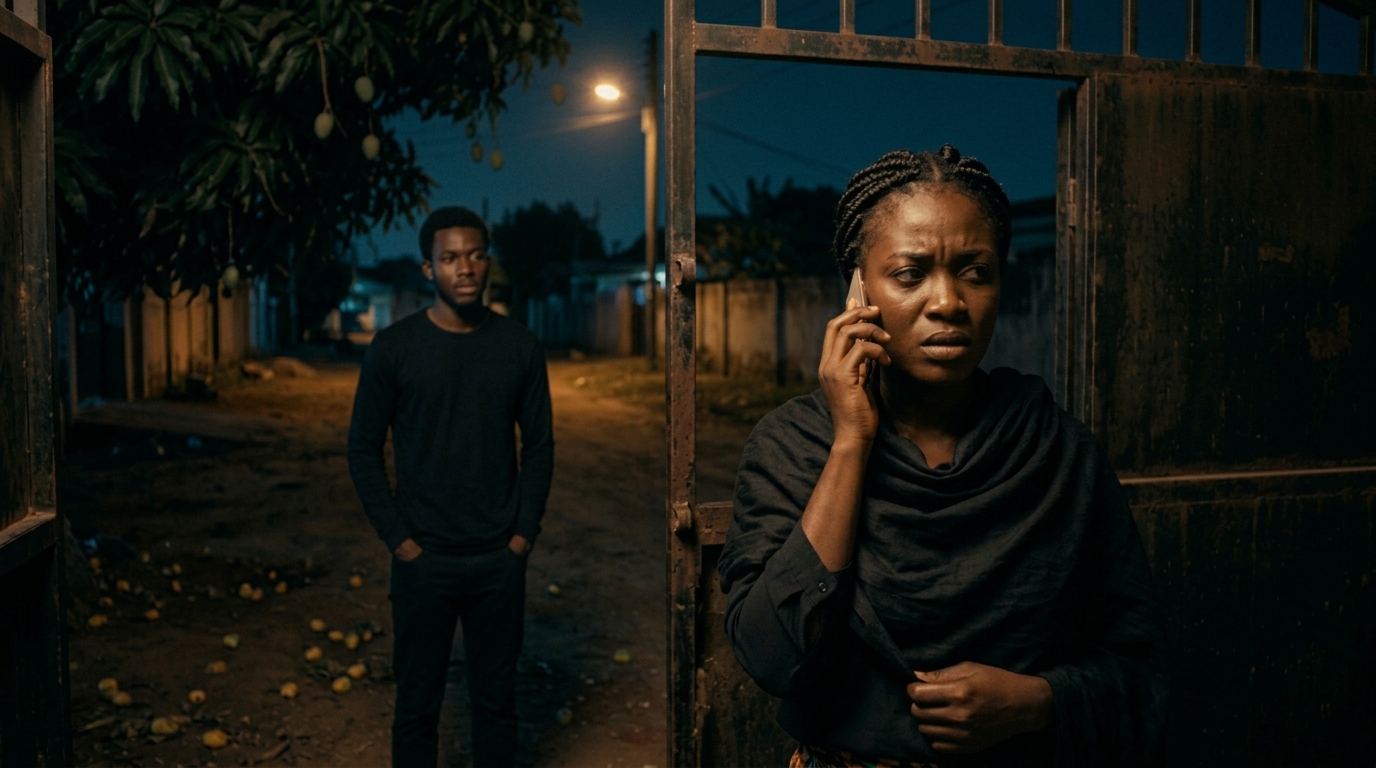
“You shouldn’t be here,” Adjoa whispered, pulling her mother’s old cloth tighter around her shoulders. Behind her, the house slept on, unaware that the front gate had just let six years back into the compound.
“I know.” He didn’t move closer. That, more than anything, was what undid her a little — the old Yaw would have crossed the distance already, would have reached for her hand before either of them had finished a sentence. This Yaw stayed exactly where he stood, as if he had spent six years in England learning, the hard way, the cost of taking a woman’s yes for granted. “I’m not here to make trouble, Adjoa. I told myself I would just look at your face one time and go home. I didn’t even plan to knock. I was standing under that mango tree for almost twenty minutes arguing with myself before my hand did it without asking permission.”
Somewhere behind her, a shutter groaned in the wind, and Adjoa’s heart lurched hard enough that she actually turned to check her mother’s window. Dark. Still asleep.
“Twenty minutes,” she repeated, mostly to have something safe to say.
“I counted the mangoes that fell while I waited. Four.” A small, helpless smile. “Some things about me haven’t changed. I still count useless things when I’m afraid.”
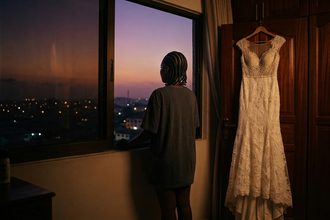
She almost laughed — an old, dangerous reflex, the specific laugh that used to arrive only for him, back when laughing near Yaw Boateng had been the easiest thing in the world. She caught it before it fully escaped and folded her arms instead, putting the gate’s iron bars more firmly between the version of herself that wanted to reach for him and the version that had a cathedral booked for ten o’clock.
“Say what you came to say,” she said. “Quickly. Before somebody wakes up and finds their bride-to-be at the gate with a strange man at midnight.”
Yaw exhaled, and something in his shoulders dropped, as though he’d been braced for her to simply close the gate and be done with him. “I’m not asking you to leave him. I want you to hear that first, clearly, so you don’t spend tonight thinking I came here to steal a bride. I came because I have spent six years telling myself a story where I did the responsible thing — I focused on my studies, I built a career, I told myself distance was a test of love instead of the slow death of it — and I never once let myself think about whether that story was actually true, or whether I was just a coward who let silence do the breaking up so neither of us would have to say the ugly words out loud.”
“And now? After I’m getting married in—” she stopped herself doing the arithmetic out loud, though her body had already done it without her permission, some clock behind her ribs ticking down toward ten a.m. “—in a few hours, you’ve decided the story wasn’t true?”
“I decided it three months ago, the day I landed at Kotoka and my mother asked me, before she even asked about my job, whether I’d found a woman in England to marry. And I told her no, because the truth is I never stopped comparing every woman I met in Manchester to a girl who used to fall asleep over her books in the KNUST library with plantain going cold beside her.” His voice cracked slightly on the last word, and he looked, for a moment, exactly as young as he’d been the night he left for the airport. “I didn’t come back for you, Adjoa. I want to be honest — I came back because Ghana is home and Stanbic offered good money and my mother is getting old. But since I’ve been back, every single day has felt like walking around a city that’s haunted by a version of my life I never got to live.”
Adjoa’s throat had gone tight enough that she wasn’t sure her voice would survive being used. She stared past him, at the mango tree, at the four fallen mangoes he’d apparently counted while working up the nerve to knock, and tried to find her way back to the version of tonight where she was simply a bride with wedding-eve jitters, nothing more complicated than that.
“I loved him honestly, Yaw. I still do. This isn’t some story where I’ve been secretly unhappy for two years, waiting for you to come rescue me. Kwame is a good man. He has never once made me feel small, or unheard, or like an afterthought to his own ambitions.”
“I believe you.” And to his credit, he said it without any bitterness at all, which somehow made it worse. “I’m not asking you to tell me he’s wrong for you. I’m only asking you to be sure — completely sure, the way a woman should be sure before she stands in front of a cathedral full of people — that marrying him tomorrow is a choice you’re making toward something, and not a choice you’re making away from something you were too afraid to look at directly. That’s all. That’s the only thing I drove here at midnight to say.”
The silence that followed had a texture to it, thick and humming, the kind of silence Accra rarely offered even at this hour — no trotro horns now, no distant highlife, just the two of them and the gate’s iron bars and the small sound of Yaw’s breathing settling, as though he’d finally set down a weight he’d been carrying since the day his taxi pulled away from this same compound six years ago.
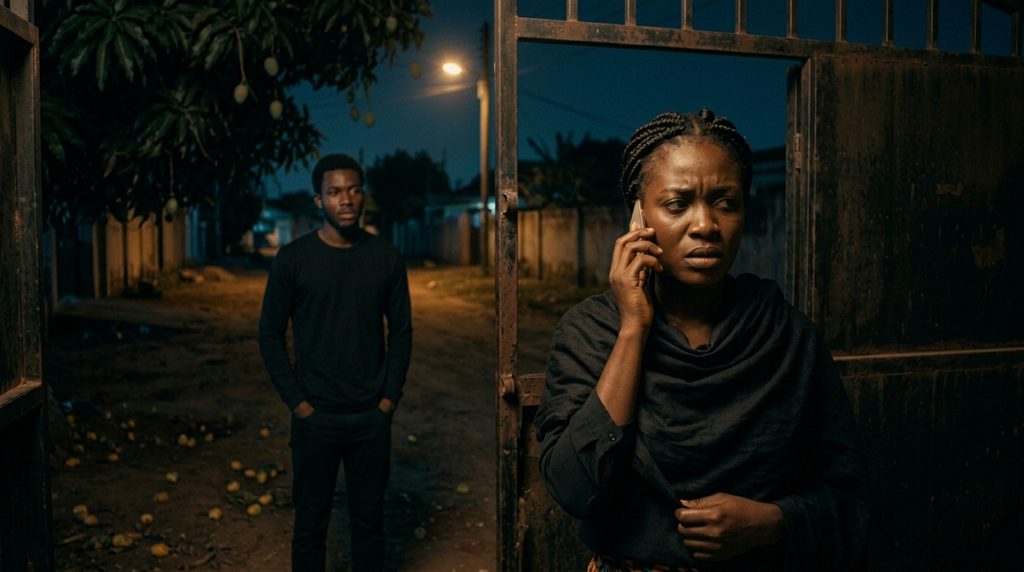
It was her phone, buzzing hard in her cloth pocket, that broke it.
KWAME, the screen said, the little photo of him in his navy suit lighting up her palm.
Adjoa’s whole body went cold in a way the Accra night, warm and close, had no business allowing.
He never called this late. He was three hundred kilometers away on the Takoradi road, meant to be resting before his own long drive back for the ten o’clock ceremony — but here he was, calling at nearly one in the morning, and some old, reliable instinct told her, even before she answered, that this was not a man calling simply to say goodnight.
She looked up at Yaw, phone glowing accusation between them, and for one long second neither of them moved.
Then, from the upstairs window, her mother’s voice cut through the dark, sharp with the particular alarm of a woman who has just woken to find her daughter’s bed empty the night before a wedding.
“Adjoa? Adjoa, is that you down there? Who is at this gate at this hour?”
The phone kept buzzing in her hand. Her mother’s footsteps were already crossing the floor above. And Yaw stood exactly where he’d stood the whole conversation, waiting — not for her to choose him, she understood suddenly, but simply for her to choose, at last, for herself.
Adjoa answered the phone.
“Kwame,” she said, her voice steadier than she had any right to expect. “Why are you calling me at one in the morning?”
The pause on the other end lasted just a beat too long.
“Adjoa,” he said finally, and something in the careful way he said her name told her, before he’d spoken another word, that this night was not finished handing her things she would need to be brave for. “We need to talk. Tonight. There’s something about my family’s business I should have told you a long time ago, and I would rather you hear it from me before the wedding than hear it from someone else after.”
To be continued in Episode 3…
Drop a comment: is Kwame finally about to confess something real — or has Yaw’s late-night visit made Adjoa suspicious of everyone tonight? 👀