
“Beloved, do not believe every spirit, but test the spirits, whether they are of God.” — 1 John 4:1
Prophet Elisha Bekoe did not look like a man who had grown his following from nothing in eighteen months. He looked, Abena thought, like a man who had grown a bank balance from nothing in eighteen months, which was a very different achievement wearing the same white cassock.
His camp sat on the Kumasi-Sunyani road, a plot of land that had been bare bush two years ago and was now a half-finished auditorium with a car park full of SUVs that did not belong to the market women and taxi drivers who filled his benches every Friday night. “Fire and Fortune Prayer Camp,” the signboard read, and Abena’s mother had been attending faithfully since the week her provisions kiosk in Bantama started losing customers to a new supermarket down the road.
“Prophet Elisha saw it in a vision,” Auntie Adobea told her daughter one evening, eyes shining with the particular hope of a woman who has been struggling quietly for months and has just been handed, for the first time, an explanation that isn’t her own fault. “He said a spirit husband from my village has attached itself to my business since I refused a marriage proposal twenty years ago. He said unless I break the covenant, I will keep losing until I lose everything.”
“Mama. You refused a marriage proposal because the man was already married to two other women.”
“Abena, you did not hear the prophecy. He described the man’s face. He described the exact color of cloth my mother wore at my outdooring, which nobody alive today could know except through the Spirit.”
Abena, twenty-four years old and two years into a business administration degree that had taught her, if nothing else, to be suspicious of anyone who was extremely confident and extremely specific at the same time, asked the obvious question. “And how does one break a spiritual covenant, Mama?”
Her mother’s hands went still around the bowl of groundnut soup she was stirring. “He said I must bring a sacrificial seed. Something of real value, not small money, because the covenant that binds me was made with something valuable, and only something valuable can cancel it. He said…” She hesitated. “He said the land title for the kiosk plot. Just to hold, Abena, as a point of contact for the prayer. He will return it once the breakthrough manifests.”
Abena set down her spoon very carefully, the way you set down something you are afraid you might otherwise throw.
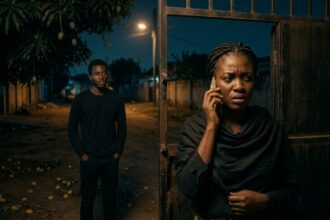
She did not go to the camp that Friday to fight. She went to watch.
Prophet Elisha worked the crowd the way a good trader works Kejetia Market — reading faces, testing reactions, adjusting his pitch to whichever nerve twitched first. “I see a woman here tonight,” he called out, eyes closed, swaying slightly under the floodlights his brother operated from a small mixing desk at the back, “a woman whose younger sister has been secretly jealous of her since childhood, sending bad dreams…” A woman near the front gasped and began weeping before he’d finished the sentence, and Abena watched three ushers move toward her with practiced speed, guiding her forward for “further ministration” — which, Abena had already learned from two other market women that week, always eventually arrived at a specific cedi amount, or a specific asset, required to complete the deliverance.
After the service, loitering near the car park where the SUVs sat gleaming under the compound’s single generator-powered floodlight, Abena struck up a conversation with a young usher taking a cigarette break well out of the prophet’s sightline — the kind of man who talks more freely once he’s decided you’re not one of the true believers.
“Small small, we get information,” he admitted, after Abena bought him a cold Malta and let a comfortable silence do most of her interrogating for her. “Before the big prophecies, the ushers move around during offering time, during testimony time, listening. Somebody mentions their sister on the phone, somebody’s WhatsApp status says ‘trusting God for my kiosk,’ somebody’s neighbor gossips at the borehole. We write it small small on paper, pass it to Prophet’s brother at the mixing desk, he types it to Prophet’s earpiece before the ‘vision’ comes. It is not witchcraft, sister. It is just… business intelligence.”
“And the assets people sign over?”
The usher’s cigarette paused halfway to his mouth. “That one,” he said quietly, “I don’t like to talk about.”
Abena brought what she’d learned to the one person in the family whose word still carried weight with her mother — Elder Kwame Osei, a retired schoolteacher and the last surviving deacon from the small Presbyterian congregation Auntie Adobea had attended before Fire and Fortune opened its doors and offered something the old church never had: quick answers to slow, patient suffering.
Elder Osei did not go to expose the prophet with shouting or accusation. He went, the following Friday, and stood quietly at the back during testimony time, and when Prophet Elisha’s eyes swept the crowd for his next “vision,” the old man simply raised his hand and asked, in a voice too calm and too carrying to be shouted down, “Prophet, before you continue — can you tell this congregation what the Bible says a true prophet must never do with the word of the Lord? Micah 3:11 — her prophets divine for money. Since when did the Holy Spirit require a land title as a point of contact?”
The murmur that moved through the benches was not loud, but it was the particular murmur of a crowd remembering, all at once, something they had each individually chosen to forget. By the time the ushers who normally guided weeping women “forward for ministration” thought to intervene, half the congregation was already asking, out loud, why nobody’s returned asset had ever actually come back multiplied the way it had been promised.
Fire and Fortune Prayer Camp did not close that night. But within two months, its floodlit car park held noticeably fewer SUVs, and Auntie Adobea’s kiosk plot title — after one deeply uncomfortable meeting Abena insisted on attending personally, folder of dated WhatsApp screenshots in hand — was returned to its rightful owner, with no multiplication and no apology, only the quiet, grudging silence of a man whose business intelligence had, for once, met better intelligence than his own.
“Test every spirit, Mama,” Abena told her that evening, echoing words Elder Osei had said at the back of a chapel two Fridays before. “Not every man wearing a cassock and calling himself Prophet is carrying the voice of God. Some of them are only carrying very good hearing, and a WhatsApp group of ushers.”
THE END